Unleashing Grid Edge Resources Could Deliver $40 Billion in Benefits

New report quantifies potential value of grid edge resource in wholesale markets if policy roadblocks removed
WASHINGTON, DC – With energy affordability front-and-center in today’s policy debates, a new study quantifies the financial benefit that customer-owned energy resources could provide to wholesale markets, finding billions of dollars in savings that consumers are missing out on today.
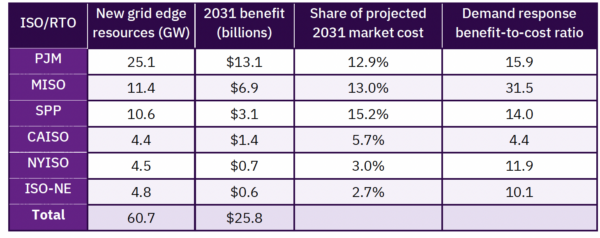
The study finds that adding 60 gigawatts of new grid edge resources – including smart thermostats, electric vehicles, heat pumps, demand response programs, as well as residential and commercial solar paired with energy storage systems – could deliver $26 billion in benefits to wholesale markets, and as much as $40 billion in benefits if existing demand response tools are put to better use. These benefits would show up on customers’ bills between now and 2031 if policy changes were made immediately.
“At a moment when state leaders are looking under sofa cushions for extra electrons and desperately searching for ways to bring down energy costs, this study shows how valuable it would be to remove regulatory red tape for grid edge resources,” said Heather O’Neill, President & CEO at Advanced Energy United. “Grid edge resources are among the lowest-cost and fastest-to-deploy tools available to meet rising energy needs. Unfortunately, outdated market rules are getting in the way.”
The report, available at UnleashGridEdge.org, builds on U.S. Department of Energy estimates, and assumes grid edge resources serve 20% of peak load across the six ISO/RTO energy markets (PJM, MISO, SPP, NYISO, ISO-NE, and CAISO). The study also finds that:
- Nearly every resource pays for itself. Demand response returns more than $10 for every $1 spent in five of six regions, and more than $30 in MISO.
- Savings reach every customer, not just the homes and businesses that host these resources, by lowering peak energy prices and capacity costs, relieving congestion, deferring transmission investment, and providing low-cost capacity during grid emergencies.
While FERC Orders 745, 841, and 2222 opened wholesale markets to demand response (DR) and distributed energy resource (DER) solutions, market rules have not kept pace with how the grid operates today. The study also identifies five barriers that the Federal Energy Regulatory Commission (FERC), grid operators, and state regulators must address:
- Demand response participation models built for summer peaks that fail to accommodate different types of load.
- Metering requirements designed for large generators that impose disproportionate costs on small, aggregated resources.
- Planning and interconnection processes that leave grid– edge resources out of transmission and distribution plans and study them separately from the loads they serve.
- Capacity accreditation modeling that produces artificially low and volatile values for short-duration resources, undermining project financing.
- Net metering rules that bar behind-the-meter solar plus storage from responding to ISO/RTO dispatch during grid emergencies.
“Grid edge resources can deliver billions of dollars in savings to consumers, strengthen reliability during emergencies, and reduce the need for costly new infrastructure at a time when electricity demand is rising faster than new supply can be built,” said Caitlin Marquis, Managing Director at Advanced Energy United, leading the organization’s engagement with wholesale markets. “Federal and state regulators, as well as grid operators, can take immediate steps to make sure consumers aren’t paying more for their electricity than is necessary.”
All energy markets come out ahead
Adding grid edge resources provides different values to different wholesale markets, ranging from roughly half-a-billion in benefits to some of the smaller markets, to roughly $13 billion in benefits to the nation’s largest grid operator. Benefits vary in part due to the variance of existing market penetration of grid edge resources.
Access the full report here.