As Energy Demand Spikes, New Study Shows How Mid-Atlantic States Can Affordably Avoid Power Outages
Grid operator PJM Interconnection can avoid 97% of expected bulk system outages by deploying more advanced energy technologies
WASHINGTON, DC – The Mid-Atlantic and parts of the Midwest could experience 97% fewer power outages by 2030 if the region deploys more advanced energy technologies, according to a new analysis.
This increased reliability would also come at a lower cost. Adding more advanced energy technologies in the region would create a cumulative cost savings of $178 billion over the next decade, or about 20% less costly overall than the status quo course. To realize this reliable, lower-cost grid, the Mid-Atlantic and Midwest can pursue an ambitious but achievable deployment of advanced energy technologies including large-scale wind, solar, and battery storage infrastructure, maximize energy efficiency, move power more efficiently using advanced transmission technologies, and harness local energy resources (via demand response and virtual power plants).
“Panic appears to be driving a lot of people to look to the same solutions we’ve relied on in the past, but new gas generation can’t be deployed fast enough to meet our immediate energy needs,” said Jon Gordon, a Senior Director at Advanced Energy United. “This analysis shows we’re headed for more frequent and longer outages unless states and grid operators urgently take action to make it easier to build and deploy advanced energy technologies, both grid-scale and community-generated power. Achieving a more reliable, affordable power grid will require leaders of the 13 states within PJM, and PJM itself, to take decisive action.”
The findings come from a new report, The Next Decade in PJM: A Path to Reliability and Affordability, produced by the consulting firm Synapse Energy Economics on behalf of Advanced Energy United. The analysis modeled two scenarios: 1) a business-as-usual, gas-dependent status quo scenario that assumes limited deployment of advanced energy technologies, and 2) a second scenario with increased, but still realistic, levels of advanced energy deployment. Other variables—like the load forecast and availability of non-advanced energy resources—were held constant across the scenarios.
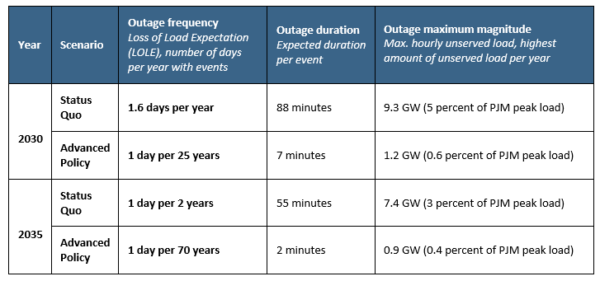
Table 1. Summary of expected PJM reliability performance by scenario in 2030 and 2035
The analysis also found that deploying more advanced energy technologies would significantly reduce the duration of outages on the bulk system (the analysis did not assess the distribution grid). In the status quo scenario, bulk power system outages are expected to last 88 minutes per event, whereas in the scenario with more advanced energy connected to the transmission grid, the expected duration is just 7 minutes per event. The report also found that increased deployment of advanced energy technologies reduces the number of customers affected by outages by 87%.
“Especially in the colder months, when gas and coal-fired power plants have higher rates of outages, advanced energy technologies could make a significant difference. In a region like PJM that is currently very highly dependent on gas and coal, adding more of these technologies would automatically increase resource diversity,” added Gordon. “PJM would do well to learn from Texas, which fortified its transmission system with technologies like battery storage over the past five years, providing flexibility that is making the Texas grid more resilient and less dependent on one fuel source.”
The PJM region currently has very limited deployment of advanced energy resources like battery storage (.2% of installed capacity), solar (1%), and wind (2%). Advanced energy technologies are the most affordable and fastest-to-build solutions to meeting our growing energy needs, but PJM’s transmission interconnection policies, cumbersome siting and permitting rules in states, as well as supply chain constraints, and are making it difficult to quickly deploy advanced energy technologies. PJM Interconnection currently expects it will not meet required power reserves starting in June 2027.
Download the report at advancedenergyunited.org/NextDecadePJM.
Additional Resources:
- A previously-developed resource from Advanced Energy United highlights three proven tools to solve PJM’s capacity crunch.
- A 2025 analysis found that consumer electricity costs could have been reduced by as much as $7 billion dollars in a recent PJM capacity auction had the grid operator’s interconnection process been working more efficiently to bring needed supply online to match demand.
- PJM Interconnection earned a D- grade in a 2024 scorecard assessing the interconnection processes of all RTOs and ISOs.