The Importance of Collaboration Among Clean Energy Trade Associations
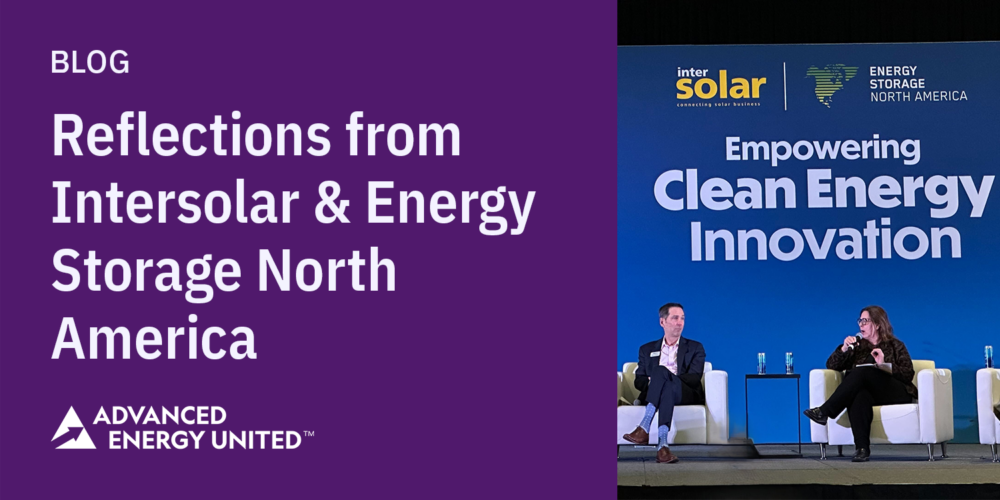
This blog was first published by Intersolar & Energy Storage North America. The original post can be viewed here.
The second keynote at the Intersolar & Energy Storage North America (IESNA) Flagship event opened with an online audience poll: is coordinating across clean energy interests difficult? 58% said it was “difficult but manageable.” Only 5% said it wasn’t a major issue. The panel took that as a starting point – and spent the session on the harder question of how to translate competing interests into collective action.
Moderated by Amy Harder, national energy correspondent for Axios, the keynote brought together Sean Gallagher, senior vice president of policy at SEIA; Heather O’Neill, president and CEO of Advanced Energy United; JC Sandberg, chief policy officer at American Clean Power; and Anna Siefken, director for policy and markets in North America at the LDES Council.
A Coalition of Competing Interests
Each panelist acknowledged the tension in representing a broad membership, especially during a politically fractured moment. Sandberg called it “tricky”: priorities don’t always align between developers, financiers, and offtakers across the full clean energy value chain.
However, all agreed that collaborative action is necessary for industry success. In fact, O’Neill described collaboration as central to Advanced Energy United’s identity. The organization operates in 18 states and five ISOs/RTOs, and working in coalition with labor, environmentalists, and sometimes even conservative groups, she said, is simply how things get done at the state level.
Siefken offered the most candid take on what lean coalition-building actually looks like. As a younger organization with a lean North American team, LDES Council relies heavily on partner networks. A recent Virginia bill on long-duration storage – which passed both chambers – required carefully coordinating advocacy timing with ACP colleagues. “AI will never replace the relationships that can happen organically between organizations to drive things forward,” she said.
Affordability: Liability Turned Opportunity
Harder turned to energy affordability – specifically, how the industry responds when the current administration blames clean energy for rising electricity costs.
Gallagher was direct: affordability is SEIA’s central messaging theme for 2026. Previously, it was a liability for clean energy, he said. In the last year, however, it’s become a positive for the industry. “In order to reduce pressure on rates, we need to put more supply on the grid. Just let us build.” The numbers are stark: the Interior Department’s permitting moratorium is threatening roughly 78 gigawatts of projects that could otherwise come online in the next few years.
O’Neill pointed to the 2025 gubernatorial elections as evidence that the message is landing in ways that matter. For the first time, she said, energy affordability was a defining issue in those races, shaping both who won and their early actions in office. In New Jersey, Governor Sherrill’s day-one executive orders centered on advanced energy technologies as affordability solutions, including a virtual power plant (VPP) program and new solicitations for large-scale solar and storage.
Sandberg acknowledged incremental progress with the administration on solar and storage, but none on wind. His approach: lead with facts, not arguments. MISO, SPP, and ERCOT are saving ratepayers money because renewable energy is a zero-cost fuel source. “The rhetoric doesn’t always match the facts on the ground,” he said. “A third of North Dakota’s generation mix is wind, and they haven’t seen blackouts.”
Siefken made the case for LDES as an affordability solution rather than a cost adder, citing a benchmarking study with EPRI that projects LDES costs falling as much as 47% by 2030. And the projects are already penciling. “Katy, Texas is a great example,” she said, pointing to a data center project where long-duration storage is proving viable. “There’s a lot of ifs in the way – siting, permitting – but Virginia is looking very good too.”
Alignment – and Its Limits
A second poll asked the audience how well the industry aligns when engaging regulators. 69% responded “somewhat.” Only 14% said “mostly.”
O’Neill cited interconnection reform as a bright spot where the industry has spoken with one voice, and highlighted Colorado as a state where coordinated advocacy is unlocking markets across large-scale, distributed, and VPP technologies. Sandberg added that the coalition itself has expanded – the industry is now working with partners it didn’t have five or seven years ago, from data center developers to manufacturing associations and large energy buyers. That broader tent, he said, is making the advocacy more effective.
When an audience member asked whether zero emissions could serve as the industry’s second tagline behind affordability, the panelists were unified: not right now, even though that’s exactly what these technologies deliver. “If we start talking about anything else, we don’t get in the door in California or Texas,” O’Neill said. The mission hasn’t changed, she added, but the language has to meet the moment. Harder noted that the pendulum has swung to affordability and resilience – and that wind, for now, has been pushed to the margins. It won’t always be this way, she said, but that’s the moment the industry is in.
The Word Cloud
Harder closed by asking the audience for one word describing clean energy coalition dynamics. Uncertainty, unstable, and fight dominated, followed by stuck, difficult, and fragmented.
Each panelist responded with their own. Sandberg said committed. Gallagher chose exciting, as the coalition is working with a broader set of partners than ever. O’Neill offered resolve: “Our technologies are the affordability solutions, the reliability solutions, the resilience solutions,” she said. “Decisionmakers are hungry for what we can provide.”
Siefken went last by choice. Her word was hope. “The infrastructure decisions we make now are for years,” she said. “The more of us who can push this in the right direction – we’re still out there. And even from the very top, it can’t change that.”
