PJM Stalled the Clean Energy Transition: Affordability and Reliability Depends on Getting it Back on Track
The news in the PJM Interconnection service region is dominated by headlines around the higher cost for electricity and grave warnings over eroding electric reliability, driven by concerns as to whether PJM has enough generation supply to keep the lights on as electric demand spikes to unprecedented levels. PJM has long relied on fossil-based generation—natural gas and coal—and, in the face of the current power supply crisis, PJM is once again turning primarily to fossil generation to try and meet these new demands. The problem is that rapidly shifting economic conditions have caused prices for new natural gas plants to spike and worse still, supply chains for critical components of new gas plants are snarled, resulting in delays of 5 to 7+ years just to get the critical components needed to construct new gas plants that PJM needs immediately.
New analysis from Synapse Energy Economics shows that turning instead to a mix of advanced energy solutions—wind, solar, battery storage, demand response, energy efficiency, and alternative transmission technologies—would allow PJM to meet its forecast demand at lower cost and with vastly improved reliability outcomes. Specifically, the report finds that accelerating deployment of these technologies would result in 20% cost savings and 97% improvement in reliability performance relative to a status quo scenario.
The PJM region currently has very limited deployment of advanced energy resources like battery storage (0.2% of installed capacity), solar (1%), and wind (2%). But not for lack of trying; developers have been working to bring new renewable and storage projects online to diversify the PJM grid mix. In early 2022, there were over 300 GW of generating capacity waiting for PJM permission to connect to the grid; 95% of that 300 GW was renewables and storage. To put that into perspective, the entire PJM region currently has 180 GW of installed generating capacity. But the vast majority of that sorely needed generating capacity has yet to start operating, and much of it never will. So, what happened to the clean energy transition in PJM that felt inevitable just a few years ago?
How Did We Get Here?
The answer lies in PJM’s “generator interconnection” process, the series of studies used to determine both the ability of the PJM transmission grid to connect new generation, and the cost of any potential system upgrades associated with doing so. Historically, it can take two years or more for projects to move through the interconnection “queue” and ultimately get PJM’s permission to connect to the grid, and then additional time for any transmission upgrades to actually get built, so a project can start operation. The massive influx of interconnection requests by clean energy generators that began around 2018 overwhelmed PJM’s ability to conduct these individual interconnection studies. In response to the overload, PJM stopped studying new interconnection requests in 2022 and began implementing reforms to study projects in clusters rather than one-by-one. Those reforms should hopefully result in a faster process—although PJM’s new and improved approach will still take 1-2 years, far longer than the 150-day study requirement set by the Federal Energy Regulatory Committee in its landmark Order No. 2023.
That brings us to where we are today: because PJM effectively closed the queue for new projects while they dealt with the backlog, any project that applied for interconnection after 2022 is still waiting for its interconnection study to begin. Given the timing of the region’s data center boom, the queue closure left PJM underprepared to bring on new supply at the time of greatest need.
From 2013 to 2023, very little new capacity deployed in PJM came from renewable energy or battery storage. Meanwhile, during that same time in all the other U.S. RTOs, much of their newly deployed generation was renewable and storage. Compared to all other U.S. RTOs, PJM had the highest level of new fossil powered generation deployment from 2013 to 2023. In PJM, 66% of all new generation additions were fossil fueled compared to: 0% in CAISO (California); 10% in ERCOT (Texas); .5% MISO; 0% SPP; 29% SERC; 29% NYISO; 40% ISONE (see Chart A below).
Some critics have pointed to a fossil fuel bias inherent in the PJM governance structure that is often dominated by incumbent generator interests as a possible cause, but clearly, the clogged interconnection queue has played a huge role—the queue was the primary reason clean energy has not yet shown up to the extent needed and expected in PJM. Since 2022, 174 GW of generation projects have voluntarily withdrawn from the queue (see Chart B below), as both interconnection and project development costs skyrocketed. According to PJM, they have “processed” more than 170 GW of new generation requests in their interconnection queue since 2023, but that number actually reflects mostly all the withdrawn projects since 2020. We will never know how many of the withdrawn projects could have avoided that fate if they had spent less time languishing in the queue while market conditions, the policy and regulatory landscape, best available technology, and supply chain constraints changed around them. Even more projects would have likely survived had PJM moved more quickly to initiate long-term transmission planning that would have reduced the sticker shock for new resources seeking to connect to the grid.
The impact on customers of that failure is significant. Analysis from Grid Strategies indicates that a faster, simpler process to connect just 15% of the proposed generation currently in the PJM queue likely would have yielded more than the ~10 GW in accredited capacity needed to bring auction costs in line with historical norms, reducing the cost of the 2025/2026 auction by as much as $7 billion. The new Synapse study shows that the expected frequency of outages in 2030 could be reduced by 97% at a much lower cost, with advanced energy technologies offering a cumulative cost savings of $178 billion, or 20%, relative to business as usual in PJM.
Looking Forward
PJM plans to reopen the long-closed interconnection queue in April 2026, promising a one-to-two year timeline for new interconnection studies. If PJM hits the low end of that target, this new process will deliver much-needed relief. The problem is, PJM needs new generation now to avoid price spikes and reliability concerns.
So instead, PJM has turned to stop-gap measures that threaten to do more harm than good. PJM’s Reliability Resource Initiative allowed 51 projects to skip the line and join one of the ongoing transitional interconnection studies ahead of other new requests. While the RRI did include some storage projects, it was mostly dominated by gas, nuclear, and even coal, and renewable energy was excluded by the eligibility parameters. And lack of transmission capacity due to poor forward grid planning has caused even some of these supposedly “shovel-ready” projects to die on the vine.
Now, PJM is proposing another workaround, the “Expedited Interconnection Track,” that will allow up to 10 projects per year, a highly coveted 10-month fast-track study. The eligibility parameters of the EIT will effectively block new wind, solar, and storage standalone and hybrid projects from accessing this faster study process. The EIT is in effect an admission by PJM that its interconnection reforms are too little, too late to address impending load growth.
These stop-gap processes are unlikely to deliver meaningful relief in the near-term, since they do not magically waive supply chain challenges, permitting delays, and costly grid constraints; and they are very likely to inflict harm in the long-term by diverting time, resources, and priority grid access away from projects waiting patiently in the standard queue.
Rather than rely on emergency workarounds, PJM should double down on fixing the interconnection queue so that it is efficient and predictable for all projects. PJM can do that by meeting the lower end of its one-to-two-year estimate for its first cluster study under its reformed process, and by committing to achieve the 150-day FERC-mandated timeline. Other steps PJM can take include following through and expanding efforts to apply automation and artificial intelligence tools to speed up the queue, prioritizing the most cost-effective solutions for resolving reliability violations, reforming the energy-only interconnection track, ensuring that surplus interconnection pathways are workable in practice, and addressing delays that occur after an interconnection agreement. PJM should also work with stakeholders to explore a more predictable, proactive approach to interconnection, borrowing from the innovative “Consolidated Planning Process” recently filed at FERC by the Southwest Power Pool.
The PJM region is already paying the price for the failure to act sooner to address systemic interconnection bottlenecks—we cannot allow history to repeat itself. There are a lot of pressing issues facing PJM, but continuous, iterative improvement to the interconnection process must remain a perennial top priority if we want to diversify the grid mix and realize cost savings and reliability benefits by bringing online more advanced energy resources—and quickly.
Chart A (US RTO generating capacity added and withdrawn by type 2013-2023; Source)
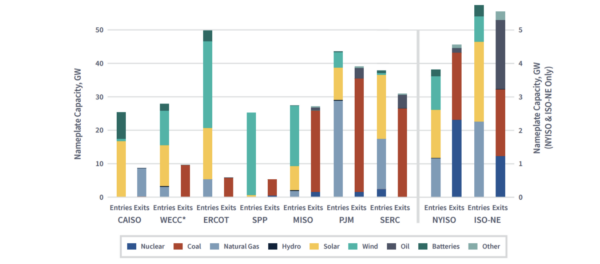
Chart B (MW and project withdrawals from the PJM interconnection queue by year; Source)
