Five Lessons Learned from Advanced Energy United’s Executive Forum on Integrated Gas and Electric Planning
You may not have heard of it yet, but there’s a new energy planning reform quietly spreading across North America: Integrated Gas and Electric Planning (IGEP). The energy affordability crisis, accelerating gas-to-electric fuel switching, winter reliability challenges during cold snaps, and load growth-related demand for new gas are pushing utilities and state decisionmakers to rethink how they plan for energy needs. They’re looking for new ways to 1) understand the interdependencies of our gas and electric systems, and 2) optimize how we spend our limited ratepayer dollars on the investment that offers the biggest bang for our buck.
IGEP is an emerging set of planning and analytical practices to coordinate between historically siloed electric and gas utilities to address joint electric and gas risks and minimize utility costs.
There are already signs of momentum:
- Washington passed legislation that directed Puget Sound Energy to file an Integrated System Plan, beginning in 2027, to support meeting the state’s climate goals at lowest cost;
- Avista, also in Washington, launched a voluntary effort to create an Integrated Planning & Clean Energy Group in response to extreme cold in 2024 that caused low pressure on the gas system, threatening both customer heating and electric generation;
- Massachusetts Department of Public Utilities Order 20-80-D outlined expectations for how gas utilities must begin coordinating with electric utilities as they meet state decarbonization goals;
- New York’s 2025 State Energy Plan has a section calling for reforms to utility practices and analytical tools to avoid overinvestment in energy infrastructure as customers electrify;
- Ontario’s Energy Board launched an initiative to establish an ongoing gas-electric coordination information sharing forum to respond to economic growth and support affordability;
- Colorado enacted legislation that directs the Public Utilities Commission to open a docket to investigate barriers to and opportunities for streamlining energy planning proceedings, integrating electric and gas system planning, and maximizing the efficiency and effectiveness of customer programming; and
- Pacific Northwest National Laboratory published a new paper on Coordinated Natural Gas and Electric Planning: Case Studies of Current Approaches and Practices.
Given the newness of IGEP, utilities and stakeholders have a lot of questions. What does integrated planning look like in practice? How do we get from here to there? Has anyone else figured it out?
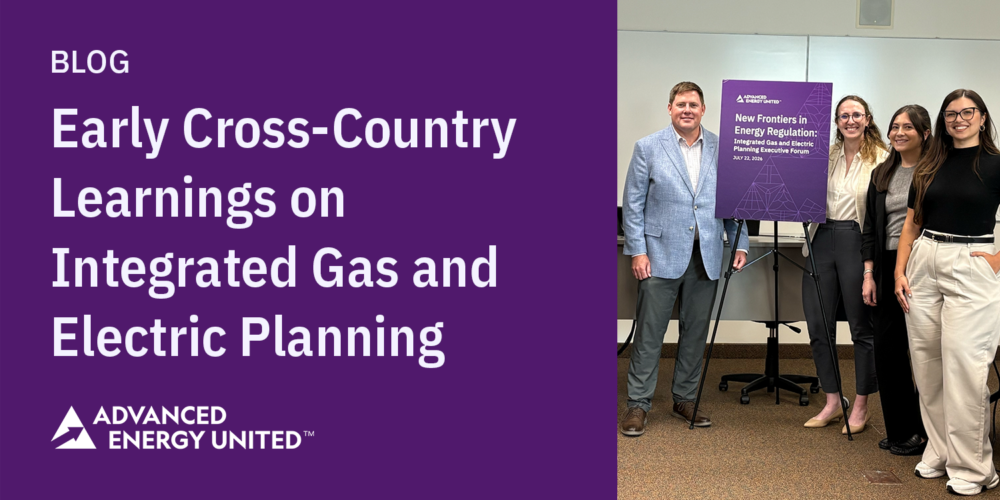
These questions formed the basis of Advanced Energy United’s latest Executive Forum: New Frontiers in Energy Regulation. In partnership with DNV, we brought together leading utilities, technology providers, researchers, stakeholders, Commissioners, and Consumer Advocates to surface the biggest technical and regulatory barriers to IGEP, to forge connections across jurisdictions, and to chart a path forward together.
Here are five takeaways from the forum:
1. Data is key, but we need to better define what we need, who needs it, and how to share it safely.
An important first step will be defining our use cases for IGEP and mapping data needs onto each use case. Then, we can begin collecting the data that we need but do not have, developing robust proxies where that can be sufficient, and sharing (safely) with relevant parties, such as other utilities, municipalities, stakeholders, and customers.
Massachusetts gas and electric utilities have already begun sharing customer usage data, household type and demographic data, and some network and infrastructure data between one another (enabled by a Department of Public Utilities Order from March 2025), but challenges and questions remain.
Importantly, utilities tend not to know what appliances are in their customers’ buildings, how old those appliances are, the size of each customers’ electric panel, and where an individual customers’ service line connects to upstream infrastructure. Hourly gas data may not be sufficient for understanding the impacts of fuel-switching on the electric system, and it is not always easy to get buy-in from regulators on the need to invest in new software or data systems. At the same time, utilities do have data that is not yet being fully leveraged, especially in planning.
2. Traditional utility gas and electric planning models are not designed to integrate with one another and often cannot map directly onto one another.
We need to move towards new tools and/or processes that can perform either “iterative modeling” (moving from one to another and then back again), or “combined modeling” where both energy systems can be reflected in one tool, and under a range of scenarios. Overlaying the two distribution systems within a model is a good start for localized projects, but as electrification scales, impacts will flow further upstream to implicate transmission and generation. The industry has work to do to enable models to talk to one another in the same language, though options do exist today (both 3rd party and in-house utility programs).
3. With or without state direction, there are many reasons to show up for this conversation.
Forum participants noted that many states have been specific in outlining the future of the electric system. By contrast, planning the gas system has been left for interpretation. That can make IGEP hard to prioritize, and it can make the state’s “use case” for IGEP unclear. In turn, an unclear use case means unclear data needs. But still, changes to customer demand and electrification trends, large load competition for gas resources, capacity constraints, regulatory orders, interest in thermal energy networks, and affordability are all reasons to begin this conversation–with or without a specific state vision and with or without climate or decarbonization goals.
4. Everyone could do a better job at learning from pilots and figuring out where they do not have to “reinvent the wheel.”
Echoing conversations across the advanced energy industry, forum participants wanted to learn from each other’s pilot projects and how they could best apply lessons learned from another context to their own. Pilots are extremely useful for testing new approaches, but they can become a bottleneck if the industry is otherwise ready to scale. While states and utilities each operate in unique contexts, they are not always so unique that each has to start from scratch. Do we simply not know what others have done, or are we distinguishing our own situations too heavily?
5. Uncertainty and inconsistency in cost recovery and cost-effectiveness hinder progress.
Several significant, but not insurmountable, regulatory challenges were named. These include: 1) the higher levels of scrutiny of energy efficiency programs, electrification, non-pipeline alternatives compared to much bigger and more expensive traditional utility investment, 2) inconsistent cost tests across jurisdictions when applied to programs versus infrastructure (and more generally, is IGEP a program subject to cost tests, or a planning framework focused on optimization?), 3) mismatched planning and rate case horizons that make it hard to “count” longer term savings of non-traditional investments, and 4) uncertainty around what costs are appropriate for a utility to earn on, especially when the investments are in lieu of more traditional pipe or wire infrastructure. The first three challenges may more easily be addressed at Public Utility Commissions, the fourth is a deeper, and more contentious, question of policy.
Continue collaborative conversations and piloting projects
This Forum was an excellent first opportunity to get experts together to lay out the biggest open questions related to IGEP. There was clear enthusiasm in the room to continue the conversation, iterate on solutions, and share across borders. Advanced Energy United looks forward to future collaborative work with utilities, commissions, industry experts, and thought partners to solve the challenges identified. And for all those interested in joining the effort, contact Sarah Steinberg.