Colorado Legislative Session Notches Steady Progress for Energy, Sets the Stage for What’s Next
No two legislative sessions in Colorado unfold in quite the same way, and this year was no exception. As this year’s session came into focus with an even more dire budget hole than the session before, and in an election year no less, lawmakers felt the pressure to close critical policy gaps that had stalled in prior years but remained barriers to delivering affordable, clean energy to Coloradans.
Faced with rising costs, fiscal duress, and persisting uncertainty at the federal level, energy policymaking this session moved on multiple fronts at once—reflecting a newfound momentum around energy affordability and foreshadowing the emergence of new clean energy champions in the final year of Governor Polis’ tenure. While some energy bills did not make it through the gauntlet due to fiscal restraint and other political headwinds, affordability and reliability were top of mind for legislators and shaped much of the session’s energy priorities.
Big wins for transmission modernization and integrated planning
One of the session’s biggest legislative wins was the Colorado Grid Optimization Act, House Bill (HB) 1081, a bipartisan measure revived from last year, that Advanced Energy United spearheaded to modernize the state’s existing transmission lines.
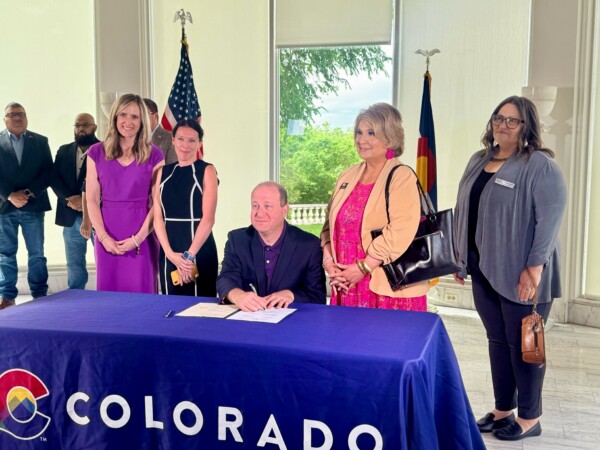
From left to right: Clean Air Task Force’s Sara Orrange, United’s Emilie Olson, Governor Jared Polis, House Majority Leader Monica Duran, and Audubon Rockies’ Daly Edmunds at the signing of the Colorado Grid Optimization Act.
United worked closely with the bill sponsors, House Majority Leader Monica Duran, Representative Sean Camacho, and Senator Dylan Roberts, as well as industry allies and environmental advocates, to shepherd this widely supported bill through the legislative process. The bill will expand transmission capacity, reduce grid congestion, and help move cleaner and more affordable energy more efficiently around the state. It requires utilities to evaluate and incorporate advanced transmission technologies (ATTs, such as advanced conductors, sensors, and software) into long-term transmission planning, reflecting a broader push toward faster, more cost-effective grid solutions without relying solely on lengthy transmission buildouts. United will track the implementation of this law with the inclusion of the ATTs evaluation within the utilities’ next Rule 3627 planning filings in 2028, as well as a forthcoming rulemaking to revamp various aspects of transmission planning in Colorado.
Additionally, the bill recognizes and supports the critical role that the Colorado Electric Transmission Authority (CETA) can play in regional and sub-regional transmission planning coordination and improves information-sharing for the legislature to more readily follow along with CETA’s successes and evolving work.
The much-anticipated Public Utilities Commission (PUC) sunset bill, HB 1326, featured as another one of Colorado’s major energy policies to unfold this session. While the recommendations presented in the Department of Regulatory Agencies’ “PUC Sunset Report 2025” served as its initial template, the bill evolved continuously through the final days of session due to challenging negotiations.
Ultimately, the bill reauthorizes the PUC through 2033, and opens the door for more streamlined, cross-system regulatory processes. United successfully advocated for the addition of legislative language directing the PUC to initiate an investigatory docket on the merits of, and existing barriers to, integrated gas-electric planning. This would require examination and stakeholder discussion around how to better coordinate gas and electric system planning to reduce financial risk from overbuilding, improve data sharing, reduce costs, and align utility planning with the state’s broader energy and greenhouse gas emissions goals, with specific recommendations for potential follow-on action due to the legislature by Fall 2027. The bill also cements several administrative changes or clarifications while setting the stage for other potential evolutions in utility planning, electrification, and regulation.
Throughout the session, the PUC sunset bill sponsors and advocates contended with several controversial proposals, including expanding the PUC size from 3 to 5 Commissioners. This change did not come to pass due to concerns around budget, efficiency, and potential trade-offs for public process and access. Instead, the bill authorizes an “organizational modernization study” to examine how the PUC can function better. Original provisions, meanwhile, to expand the use of securitization as a cost-reduction tool and to clarify appeal rights for local land use decisions on critical energy infrastructure projects were removed before the bill’s final passage, casualties of political negotiation.
The Governor signed the PUC sunset bill, along with the Colorado Grid Optimization Act, on May 29th.
More legislative wins in advanced energy
Senate Bill 142 marked another victory, speeding through the Legislature before heading to Governor Polis’ desk. United supported this bill as well, which establishes clear rules for developing geothermal projects and clarifies how other thermal energy projects can move forward as the state explores new approaches to heating and cooling infrastructure. It also improves coordination between utilities and local governments.
Meanwhile, the Governor spared no time signing HB 1007 into law, ushering Colorado into the growing list of states to adopt “balcony solar” legislation. In addition to enabling customers to install and use small plug-in solar devices without utility pre-approval or HOA interference, the bill reinforces customer access to meter collar adapters while maintaining certain safety guardrails.
Developments in clean transportation
Other notable bills that passed this session include clean transportation bills SB 3 and HB 1289.
SB 3 establishes a comprehensive end-of-life battery management program for EV batteries, requiring manufacturers and battery suppliers to fund and manage the collection and recycling of batteries. It also establishes recovery rates for specific critical minerals involved with EV battery manufacturing. The final bill reflects extensive stakeholder conversations and consideration for establishing a manageable compliance framework for EV manufacturers. The first of EV battery providers’ stewardship plans is due in Spring 2028.
HB 1289 restores state EV tax credits, among other clean energy tax credit modifications. The bill also retires the current practice of automatically halving the base tax credit for newly purchased or leased electric and plug-in hybrids in challenging state budget years. At the same time, the bill narrows which light-duty EV models qualify for the tax credit by lowering the manufacturer-suggested retail price (MSRP) cap from $80,000 to $50,000 or less.
Unfinished business: clean energy planning updates and data center regulation
After consecutive unsuccessful attempts to get the concept off the ground, this year was unfortunately no different for the Administration’s proposed Clean Electricity Standards legislation. Persistent opposition from local business groups, utilities, and labor proved insurmountable, and the concept again did not make it to bill introduction.
The proposal would have set interim planning targets of 90% clean by 2035 and 95% clean by 2045 on the path to 100% clean by 2050. It also would have initiated more coordinated planning for transmission and generation resource development, as well as a more structured approach to evaluating clean firm resources, within utility resource planning processes.
The legislative session also concluded without resolution for two competing data center bills—SB102 and HB1030—following a similar debate from the prior year. Each bill put forward its own distinct statewide approach for how new data center development should be regulated (or incentivized); how to allocate costs for related grid upgrades and protect ratepayers; and how to ensure energy used by and procured for data centers wouldn’t conflict with the state’s clean energy objectives. These bills were among the most high-profile energy legislation debated in the State Capitol, drawing hours of impassioned public testimony. Neither bill alone mustered enough traction to advance, and efforts to explore last-ditch compromise legislation to bridge the two fundamentally different policy paradigms floundered in the final days of the legislative session. While both bills remain stalled out for now, this topic is all but certain to resurface in 2027.
The work ahead
With just weeks to go until the primary election and subsequent activity ramping up through November, United is looking forward to the return, and new wave, of clean energy champions. Affordability and reliability concerns associated with rising energy demand will continue to drive energy policy discussions headed into next session, and state budget constraints will almost certainly remain a limiting factor for legislative feasibility.
United will engage at the ground floor as implementation processes get underway for various bills crossing over from the Legislature to the Public Utilities Commission. This includes ensuring that advanced transmission technologies are robustly incorporated into utility planning decisions in keeping with newly-signed HB1081, and that the practical barriers to, and potential applications for, better integration across utilities’ energy infrastructure planning are closely examined.
The successes and unresolved matters from this past legislative session also leave an ambitious and consequential mantle for the new Governor to assume. Among these open threads, the next Governor and incoming class of legislators will be charged with ensuring that the state is proactively preparing for load growth by looking across the entire spectrum of solutions ready to address rising electricity demand and rising costs. Thankfully, the solutions are many and Colorado is well positioned to build on a strong track record of bringing these solutions together in innovative configurations and processes. Decisionmakers should also look to opportunities to capitalize on emergent pathways for Western leaders to come together around shared strategies for cross-state planning and regional energy infrastructure that will lower costs for consumers everywhere, reduce pollution, and more efficiently move cheaper energy around the region. Advanced Energy United stands ready to work with decisionmakers, current and incoming, to forge a path through the most momentous issues facing the energy sector and consumers in the year ahead.