Building a Nation-leading Virtual Power Plant Model in Colorado
The Vision
Colorado is consistently #1 or #2 in the nation in electric vehicle (EV) sales, one of the fast-growing heat pump markets, and home and business batteries have been growing at a nearly 60% annual growth rate. Coloradans are moving fast to electrify their homes, vehicles, and businesses, but the state’s antiquated electric grid wasn’t built to accommodate the growing need.
The electric grid, mostly built in the 60s and 70s, is getting old and creaky. We know we need to update the grid to serve all the new electric devices being added every day as homes and businesses switch to more secure, efficient, and cost-effective technologies. But what if we could also leverage the flexibility inherent in all those devices to minimize the need for new infrastructure, and, in fact, make better use of the grid we already have? The electric devices found in our homes, on our roofs, and in our garages, which together are called distributed energy resources (DERs), can meaningfully contribute to the distribution system (the part of the grid that connects our homes and businesses to electricity). By building less and using the grid we already have more efficiently, we lower costs for everyone.
More grid: Less cost
What’s more, when DERs operate together, they create a virtual power plant (VPP), providing the same or even greater value as power plants hundreds of miles away, including capacity, energy, voltage control, and other “grid services.” When DERs can predictably, reliably be paid for the services they provide, a homeowner’s investment in a new heat pump furnace and water heater, or a school district’s decision to electrify a fleet of school buses, gets even easier to justify. And when electrification is a better deal for consumers, we’ll see more adoption, and more flexible DERs that can be used in VPPs. Thus, a durable, scalable compensation framework that DERs as a grid resource is a virtuous cycle:
More VPPs -> more grid services -> more compensation -> more VPPs
In the process, the grid gets modernized and built out at lower cost, and ratepayers save money from cheaper capacity, energy, and other services in their neighborhoods rather than having to rely solely on faraway power plants. It’s a win-win.
Proactive planning with flexibility in mind
In Colorado, utilities are required every two years to file distribution system plans (DSPs), which identify where the grid needs upgrades to meet future demand and how the utility plans to meet it. Traditionally, utilities rely on the status quo of reacting to customer requests, and building more poles and wires incrementally, which can be costly and time-consuming.
During the 2024 legislative session, United worked closely with organizations and legislative champions to change this dynamic and advance proactive planning– anticipating where load is coming, including from electrification – and building the grid to be ready. Senate Bill 218 also modernized planning by directing utilities to consider both traditional upgrades and flexible, distributed energy solutions.
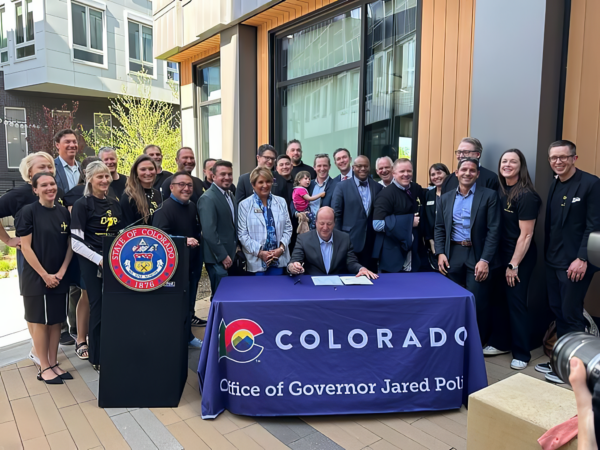
Advanced Energy United’s Emilie Olson (far left) pictured with other advocates during the signing of the “Grid of the Future” bill in 2024.
We saw an opportunity then to activate the virtuous cycle of VPPs. Our goal was to maximize how both new and existing affordable, flexible technologies are leveraged and build a durable compensation framework to expand the universe of VPPs. United recognized early on that while technologies like smart thermostats, rooftop solar, battery storage, and EV chargers offer enormous value in supporting the grid, there wasn’t a clear pathway to integrate them into the distribution system.
There are challenges, to be sure. DER-owning customers span the gamut–from families in their homes to small businesses with refrigeration and HVAC to public agencies or large corporations with a dozen facilities in the state. DERs also span a range of technologies–from thermostats to delivery trucks–manufactured by companies from around the world and coordinated (or aggregated) by different companies and software systems. Our goal was to build a truly open-access, multi-technology program in which all these actors can participate, as long as they can perform as required.
That’s why we fought hard along with our partners, in meeting after meeting and late-night negotiations, for SB 218 to include a requirement for a VPP tariff program. We worked closely with bill sponsors and coalition partners to build support through stakeholder outreach and successful communication tactics, emphasizing the benefits of DERs and the importance of reliable, performance-based compensation.
We succeeded. The legislation required a VPP program, based on an open-access tariff, available to any qualified DER aggregator using a variety of technologies. It emphasized pay-for-performance compensation for a variety of grid services. It required provisions for equitable data access, for a level playing field between third-party aggregators and the incumbent utility, and for allowing a variety of customers to participate – including current net metering customers – while ensuring consumers aren’t compensated twice for the same service. Importantly, it encouraged a five-year “lock-in” of compensation levels to provide predictability to VPP revenues.
From legislation to implementation
Passing legislation was just the first step, but turning the vision of SB 218 into a functioning program required deep engagement in the regulatory process. Much of the bill’s requirements were to be implemented through Xcel Energy’s DSP, filed in December 2024 and litigated throughout 2025. Throughout the entire proceeding, United played a key role in shaping the VPP program.
Our original strategy was to move the VPP tariff through a standalone application process. We were hopeful that a narrow scope – and the intense focus that United had helped whip up among policymakers, the press, and the public about the potential for VPPs in Colorado – would help us reach a faster resolution.
But things were not so simple. The Commission recognized VPPs’ value in relieving constraints on the grid, improving reliability, and delivering real value to customers. And as a result, the Commission chose to incorporate this effort into the broader DSP process. Because we had long positioned VPPs as integral to the distribution system, we were well-positioned to continue advocating for them within the DSP process.
Nevertheless, we didn’t want to lose the opportunity of VPPs within the vast sea of issues at play in the DSP proceeding. So, while the DSP process was underway, we began settlement negotiations with Xcel and other stakeholders to define the key program details. These discussions addressed critical questions, including compensation levels, performance requirements, and other operational logistics. United was a key dealmaker in the process, reaching across some of the traditional divides between the utility and ratepayers to clearly tie value to performance.
For instance, we fought hard to demonstrate that VPPs should be compensated for the robust avoided costs of traditional generation, transmission, and distribution costs. At the same time, we recognized compensation could be set somewhat below full avoided costs to reflect the different characteristics of VPPs and deliver clear ratepayer benefits from a cheaper resource.
Collaborating with a diverse group of stakeholders in settlement negotiations allowed us to resolve challenges and set a clear path toward program implementation that would have been much harder, if not out of reach, in a traditional litigated proceeding dependent on the Commission’s decisions.
Our collaborative work through marathon negotiation sessions produced a settlement agreement among the parties before the rest of the DSP went to hearings. United continued to advocate before the Commission to support approval of the settlement and the program’s structure until the Commission decision in December
Finally, once the Commission approved the settlement deal, United continued to play a leading role in post-decision, pre-compliance working groups to finalize remaining program details, including technical elements like baselines, communication protocols, and dispatch parameters. We resolved final sticky issues, ensuring a robust market of interested DER aggregators were ready to start providing VPP services in the state.
A national model for what comes next
As a result of two years of hard-fought advocacy, there is now a program that stands as a true national model, and a clear demonstration of what’s possible when policy, regulation, and implementation are aligned.
Integrating VPPs into distribution system planning is no longer just a vision, but is now a proven, practical solution that utilities can rely on today to manage grid constraints, improve reliability, and lower costs for customers.
The Aggregator Virtual Power Plant (AVPP) program is now live, opening the door for DER aggregators to apply and become participants. The program was designed with a clear entry pathway and performance-based compensation to encourage strong participation and deliver results from the start.
This successful legislation, and subsequent regulatory framework, are what’s possible when an industry association like United brings together a unified vision, drives policy forward, and stays engaged every step of the way.
The program creates a scalable, competitive framework that enables providers to quickly begin delivering value to ratepayers and the grid. For policymakers, regulators, and utilities, it offers a promising option to modernize the grid and unlock the full value of DERs.